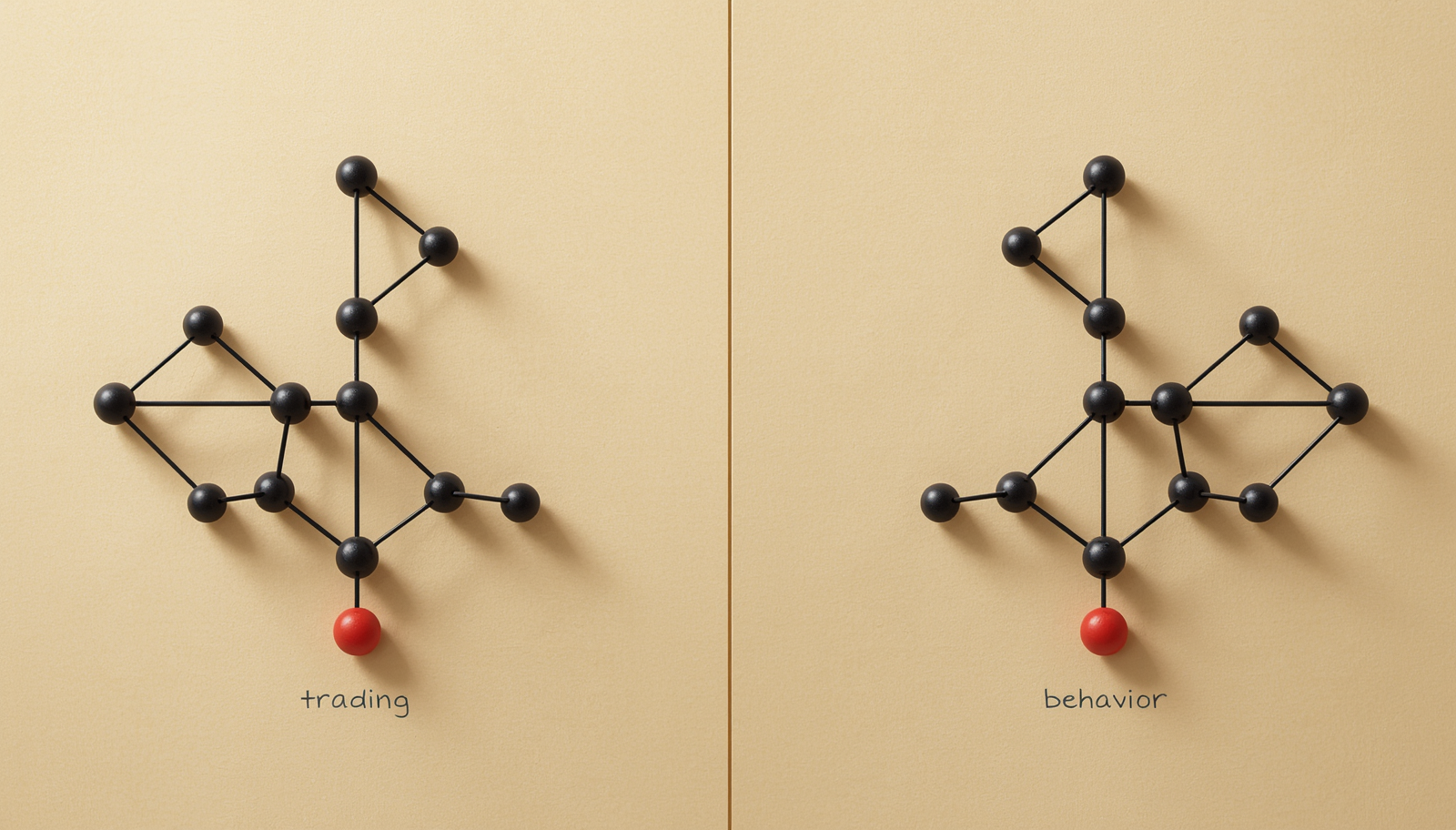
There's a pattern that shows up in two communities that almost never talk to each other. Among professional traders, it's the discipline-or-die rule that separates the ones who survive month four from the ones who blow up. Among behavior-change practitioners, it's the protocol-based intervention that survives the third-month relapse. The pattern is the same. The underlying psychology is the same. The two communities have built their own vocabulary around it without noticing they're describing the same mechanism.
If you're in either community — building trading systems, or working on behavior change — understanding the cross-domain pattern is the highest-leverage insight available. Because the failure modes that took the trading community thirty years to map are the same failure modes the behavior-change community is currently re-discovering. And vice versa.
The pattern, in plain English
In both domains, the question is the same: how does a person make a decision under conditions where their emotional state is actively working against the decision they intended to make in advance?
A trader at month four of drawdown is being asked to take a setup the bot just flagged. Every emotional signal says "don't — you're losing money, this is the wrong time, wait for the regime to come back." The pre-committed rule says "this setup qualifies, take it at full size."
A user in week eight of habit recovery is being asked to do the morning workout. Every emotional signal says "you're tired, you had a hard week, you've earned a rest." The pre-committed rule says "6am workout, regardless of how you feel."
In both cases, the question is whether the person executes the rule or executes the emotion. Decades of research in both domains converges on the same finding: the only reliable mechanism is to make the decision earlier, when emotions weren't elevated, and bind yourself to executing it later.
The technical name in behavioral economics is precommitment. The trader's name for it is "having a system." The habit-change name for it is "protocol-based intervention." They're all the same pattern: front-loaded decision, deferred execution, mechanism-enforced discipline.
What both domains learned the same way
The trading community discovered, painfully, the following:
- Strategies that work in backtest fail in live trading because the human keeps overriding them. The technology problem is solved (computers can execute rules); the psychology problem (humans intervene at the worst moments) is the hard part.
- Drawdown psychology destroys more accounts than bad strategies. A 15% drawdown on a profitable strategy is survivable. A 15% drawdown that triggers manual position-sizing changes is fatal.
- One-directional mode transitions (the system can drop to more conservative anytime, but only return to aggressive after sustained recovery) are necessary to defend against the emotional asymmetry where "I see the comeback coming" hits before the comeback actually happens.
The behavior-change community discovered, with similar pain, the following:
- Habits that work for two months fail at month three because the original motivation has worn off. The mechanism problem is solved (we know which behaviors compound); the psychology problem (sustaining the behavior under stress) is the hard part.
- The Abstinence Violation Effect destroys more recovery attempts than the slips themselves. A single missed day is survivable. A single missed day that triggers "I've already failed, might as well..." is fatal.
- Compliance windows (track 28-of-30 success, not 30-day streaks) are necessary to defend against the cognitive asymmetry where one miss feels like total failure.
Read those two lists again. The findings are identical, mapped to different domains. The mechanism the trading community calls "drawdown circuit breakers" is the mechanism behavior change calls "post-slip protocols." The thing trading psychology calls "process discipline" is what behavior science calls "protocol adherence."
Show the mechanism
Both communities have converged on a similar architecture for rule-based decision making under stress. The components:
1. Pre-committed rules made in calm states. The decision is made when emotions are at baseline. The rule is written down. The rule is specific enough that there's no judgment call required at decision time. Trading: "if D1 trend is up AND H4 order block is retested AND H1 entry trigger fires AND no news in the next 15 minutes, take the trade at standard size." Behavior: "if it is 6am on a weekday AND I am at home AND I have slept 5+ hours, I do the workout."
2. Mechanism-enforced execution. The rule isn't just remembered; it's enforced by a system the user can't easily override in the moment. Trading: an automated trading bot. Behavior: a friction-injection app, an accountability partner, a scheduled session with a coach.
3. Slip-aware metrics, not perfection metrics. Measure compliance, not perfection. Trading: equity curve relative to expected drawdown range, not zero drawdown. Behavior: "successful days in last 30," not consecutive streaks.
4. Asymmetric mode transitions. Defensive modes are easy to enter; aggressive modes are hard to return to. Trading: 5% drawdown drops you to half-size; you can only return to full size after a sustained recovery (not one good day). Behavior: a slip drops you to half intensity for a week; you can only return to full intensity after stable compliance (not one good day).
5. Post-event protocols. What you do after a bad outcome matters more than the outcome itself. Trading: a losing day triggers a review session, not a sizing change. Behavior: a slip triggers a trigger-mapping conversation, not a streak reset.
These five components, applied with discipline, are the entire game. In trading they produce systems that survive market regime changes. In behavior change they produce people who actually change. The mechanism is the same.
What this means if you're in either community
If you're a trader struggling with discipline: the literature on behavior change is more useful to you than another book on trading psychology. Specifically, read about implementation intentions (Gollwitzer's research), about the Abstinence Violation Effect (Marlatt's work), about precommitment devices. The trading community has rediscovered, with worse vocabulary, what behavioral psychologists figured out in the 1980s.
If you're working on behavior change: the trading community has built better systematic-discipline tools than the behavior-change community typically uses. The rigor with which serious traders measure compliance, define rules, and enforce execution is unusual in self-improvement contexts. The trading toolkit (state machines, hard limits, mode transitions) transfers cleanly.
If you're a builder shipping software in either domain: the architecture pattern is identical. If you've built a robust trading system with multi-agent risk validation and one-directional mode transitions, you've already built 80% of what a serious behavioral AI app needs. The remaining 20% is domain-specific surface (different triggers, different outcomes), not different mechanisms.
The convergence point
Both domains are converging toward the same product surface: AI-augmented rule-based decision systems that operate under stress conditions where human emotional state is unreliable. A serious trading system is an AI agent that knows when to take a trade, when not to, and when to shut down entirely. A serious behavioral AI app is an AI agent that knows when to intervene, what to say, and when to step back. Same architecture, different action set.
We've been working in both domains because the underlying engineering work is shared. FlowiAI Trader brings the multi-agent risk validation, one-directional mode transitions, and ICT-first analysis to traders. Woyuduin brings the same architectural rigor — compliance windows, post-slip protocols, graduated independence — to behavior change. Different products. Same mechanism.
Who should care
- Anyone working on systematic discipline in any domain — investing, fitness, recovery, productivity — the cross-domain pattern is the most generalizable insight in applied behavioral science.
- Builders considering which vertical to enter — trading and behavior-change are the two largest commercial applications of rule-based AI agents. The underlying engineering transfers between them.
- Researchers — the convergence between trading psychology and behavior-change psychology is genuinely under-explored academically. The Master's thesis is waiting.
Discipline isn't a personality trait. It's an architecture choice. Both the trading community and the behavior-change community have figured out the same architecture, in different vocabulary, on different timelines. Once you see the convergence, you can borrow the strongest tools from both sides.
If you're building serious rule-based systems for decisions under stress — in trading, in behavior change, in any other domain where emotional state is the failure mode — the architecture is what we're building across FlowiAI Trader, Woyuduin, and the Agent Memory book. Same engine, three surfaces.